
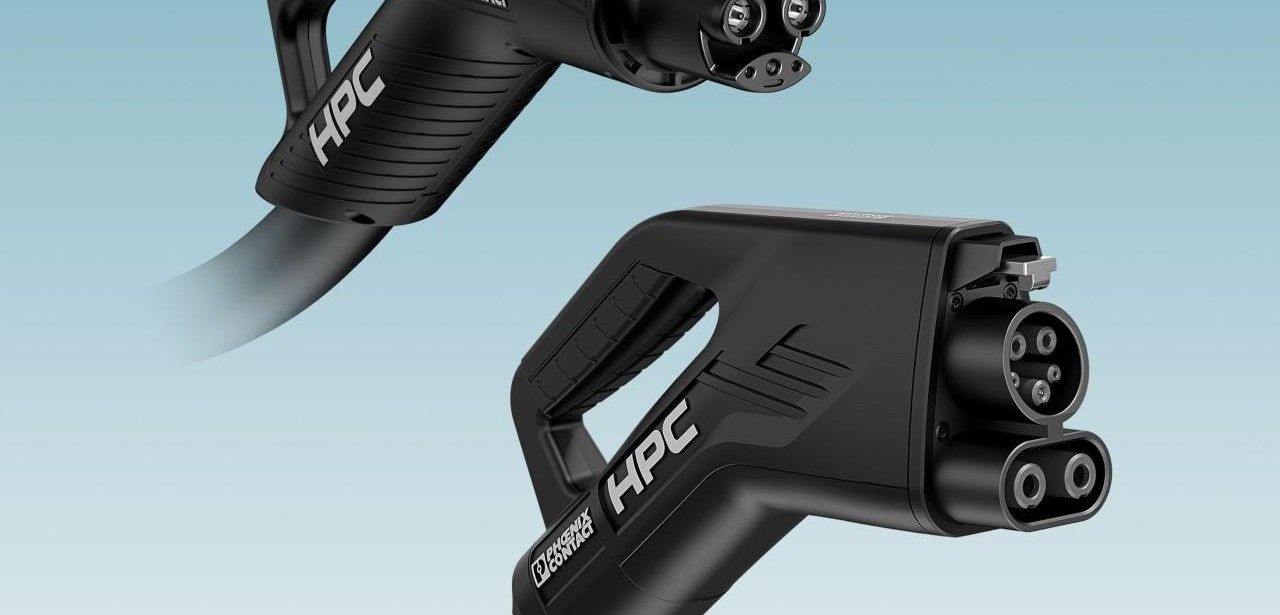
Phoenix Contact expanded its fast-charging portfolio in North America with Charx connect professional NACS and CCS Type-1 cables meeting SAE J3400, SAE J1772, UL 2251 standards. The connectors provide up to 500 kW in Boost Mode and 375 kW continuous. Ergonomic handles with thermal separation, IPXXB covers, and modular connector faces optimize safety, service, uptime. Platform compatibility across the USA, Canada, and Mexico supports rollout, with liquid-cooled NACS cables scheduled late 2026.
Table of Contents: What awaits you in this article
Phoenix Contact Debuts 500kW NACS and CCS Type-1 Cables
With the launch of NACS DC charging cables in the Charx connect professional series for the SAE J3400 standard and CCS Type 1 cables aligning with SAE J1772, Phoenix Contact reinforces its leadership in the US, Canadian, and Mexican fast charging markets. Both cable types support up to 500 kW in Boost Mode and comply with all UL safety and performance requirements, delivering reliable, charging experiences across various applications environments.
Charx Connect Professional NACS Cables Offer Enhanced Safe Handling
Charx connect professional NACS-DC charging cables feature a separately executed handle that enables secure manipulation and ensures thermal isolation from heated surfaces. The UL 2251-compliant connectors incorporate IPXXB-rated protection by means of protruding, firmly anchored plastic caps that reliably prevent inadvertent contact with live terminals. This ergonomic design not only enhances user safety during high-power charging sessions but also simplifies cable management while maintaining compliance with rigorous industry safety standards.
Charx Type-1 Cables Deliver 375 A 500 kW Boost
The Charx connect professional (375 A) and standard (200 A) CCS Type 1 charging cables are engineered for continuous currents up to 375 A and deliver up to 500 kW in Boost Mode. A dual-chamber sealing system separates DC+ and DC- conductors to prevent moisture ingress. Increased conductor cross-sections ensure efficient passive heat dissipation, eliminating the need for liquid cooling and maintaining optimum thermal management during sustained high-power charging sessions for heavy-duty automotive EV applications.
375-A Charging Cables Feature Integrated Four-Wire Metering And Compliance
375-amp variants feature an integrated four-wire measurement system that ensures compliant energy metering according to regulations. Interchangeable connector faces facilitate maintenance procedures, significantly reducing service downtime and operating expenses. A uniform cable design across NACS and CCS configurations streamlines production processes, promoting seamless platform compatibility for vehicle manufacturers and infrastructure providers. This standardized architecture simplifies engineering workflows, enabling deployment, minimizing compatibility issues, and fostering cost efficiency throughout the deployment lifecycle.
Charx connect cables minimize downtime, maximize DC infrastructure availability
All Charx connect charging cables feature an optimized architecture that reduces operational interruptions and ensures peak availability across DC charging networks. Continuous, high-resolution temperature sensing safeguards performance integrity while modular, interchangeable parts streamline repairs and maintenance, lowering total lifecycle expenses. In addition, Phoenix Contacts engineering division is developing liquid-cooled NACS cables exceeding 600 A capacity. Expected to debut by late 2026, these next-generation connectors will define forthcoming North American DC charging standards.
Expanded NACS and CCS Type-1 Cables Deliver High Performance
Phoenix Contacts expanded portfolio of NACS and CCS Type-1 charging cables delivers up to 500 kW boost power and continuous 375 kW output, ensuring rapid replenishment for electric vehicles across North America. Ergonomic handles featuring thermal isolation enhance operator safety, while modular connector heads and IPXXB protection streamline maintenance. Integrated four-wire metrology provides precise energy measurement. Unified cable architecture and standards compliance enable cross-platform interoperability, while liquid-cooled variants promise increased capacity.