
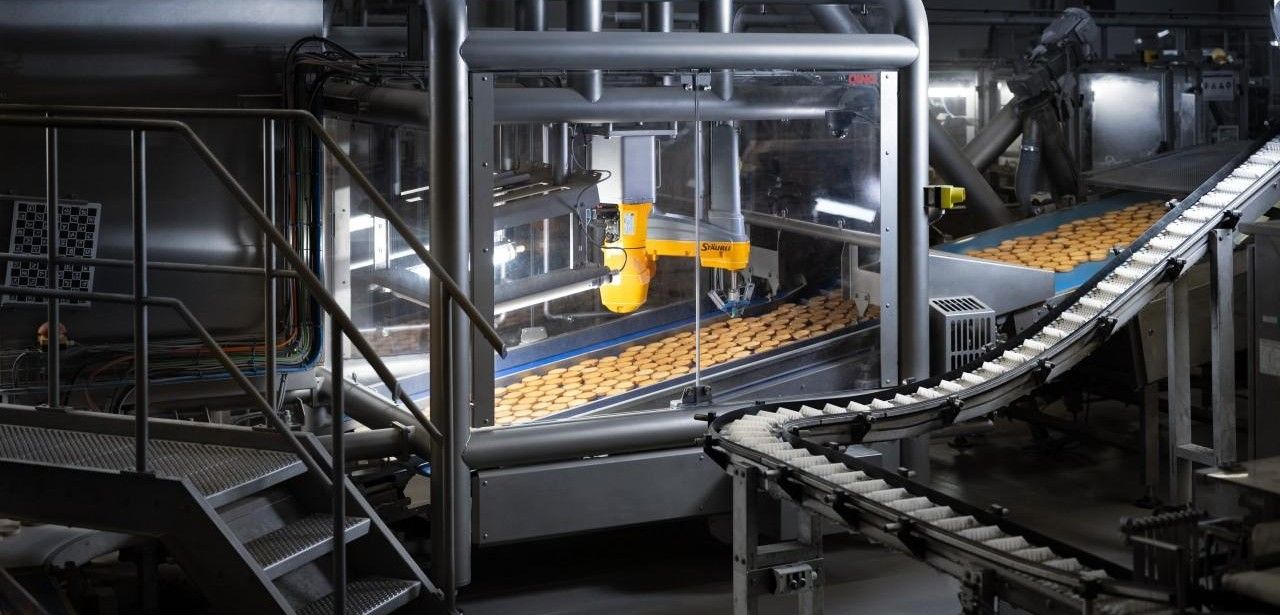
Bolletje in Almelo has integrated an automated inspection cell combining QING Food Automations STAQ framework, AI-powered vision systems and a Stäubli TS2-80 he SCARA robot. This compact solution inspects up to 1,200 zwieback slices per minute for overbrowning, stacking defects, and surface anomalies. Detected imperfections are automatically ejected while high-speed cameras capture millisecond images. Collected data feed into a real-time analytics platform enabling seamless process optimization and continuous quality assurance.
Table of Contents: What awaits you in this article
Bolletje swaps five inspectors for robotic cell improving consistency
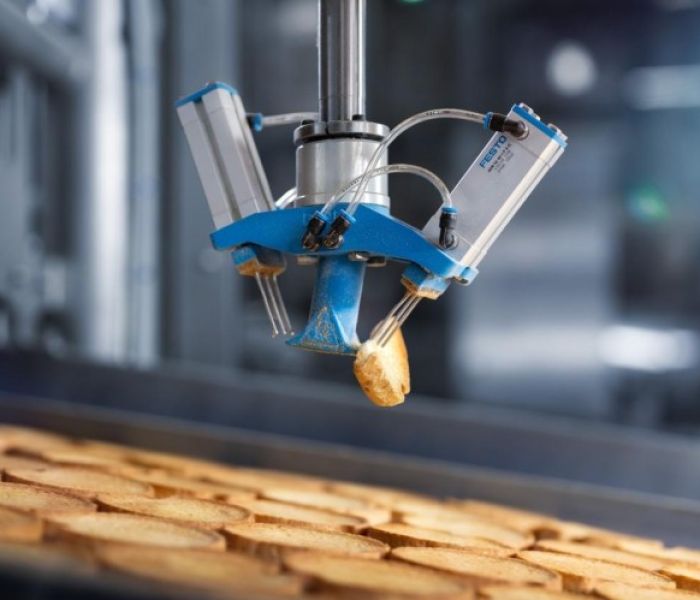
Ein speziell entwickelter Nadelgreifer (Foto: Stäubli Tec-Systems GmbH Robotics)
Until recently, Bolletjes Almelo plant relied on five operators manually inspecting up to 1,200 rusk slices per minute for over-browning and stacking flaws. This labor-intensive approach resulted in high personnel costs and restricted data collection. A few months ago, the company installed a QING Food Automation robot cell to fully automate routine inspection. Since commissioning, the system achieves consistent quality, minimizes waste, and redeploys staff towards more value-added operational tasks.
Automated oven-end inspection ensures premium quality under retail pressure
Lo Huls, Bolletjes COO, underscores the demands of automating quality inspections at the oven exit. By deploying a machine vision and AI-supported system over the 200-meter oven line, the process ensures uniform premium-quality output under increasing retail cost pressures. Real-time monitoring provides transparency, allowing immediate rejection of misbaked units. This system replacement of manual checks reduces staffing needs, minimizes human error, and secures consistent product integrity through data-driven process controls.
Compact 1.8×3.2?m inspection cell integrates seamlessly into existing conveyors
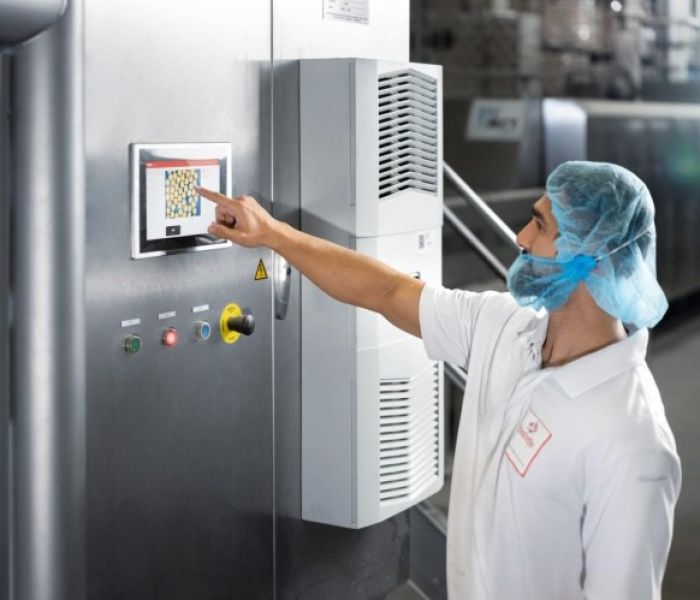
Die Mensch-Maschine-Schnittstelle des STAQ-Systems von QING (Foto: Stäubli Tec-Systems GmbH Robotics)
The inspection cell, occupying just 1.8 by 3.2 meters, integrates seamlessly into existing conveyor systems, enabling rapid quality control. A high-speed camera captures millisecond-resolution images of each rusk slice, feeding visual data to an AI-driven classifier. Meanwhile, the compact Stäubli TS2-80 he SCARA robot picks out defective items and deposits them onto two separate side chutes. Finally, perfectly inspected pieces are automatically grouped into 140-gram packages within a cycle time.
STAQ platform conducts real-time image analysis, defect parameter correlation
QINGs STAQ platform processes every frame captured, assessing image data without omission and applying real-time defect categorization against established quality criteria. By correlating fault patterns with machine parameters and production metrics, the integrated analytics module isolates underlying deviation triggers. This feedback loop empowers operators to implement preemptive adjustments, optimize throughput and reduce waste. Concurrently, the elimination of repetitive visual inspection tasks frees bakery staff to focus on more strategic operations.
QING chooses four-axis Stäubli TS2-80 he SCARA for pick-and-place
In its automated pick-and-place implementation, QING integrated the four-axis Stäubli TS2-80 he SCARA, exploiting its acceleration and footprint. Industrial hygiene standards are upheld through its certified food-grade HE configuration, enabling 24/7 operation. VALtrack software orchestrates seamless coordination between the robot and conveyor, adjusting motion profiles to match throughput demands. Equipped with a needle gripper, the system efficiently reliably executes over eighty precise picks per minute, enhancing throughput and reducing stoppages.
QING and Bolletje collaboration boosts automation through AI training
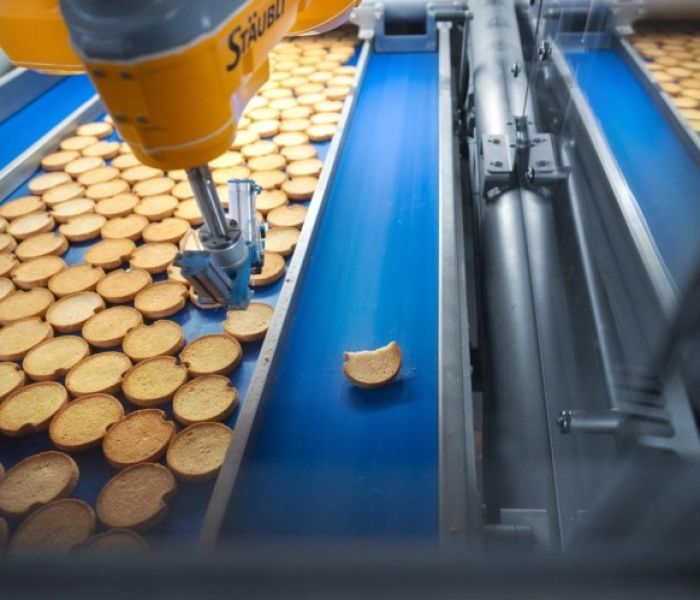
Der Roboter kann bis zu 80 Zwiebackscheiben pro Minute aussortieren (Foto: Stäubli Tec-Systems GmbH Robotics)
Project success was achieved through close collaboration between QING Food Automation and Bolletje, involving production staff from the outset. Early engagement in system design fostered trust and eliminated skepticism. Personnel toured the QING facility, evaluating automation equipment integration. Joint development of AI inspection models and iterative training enabled Bolletje to assume operational control. Continuous in-house refinement of model parameters and process monitoring ensures sustainable automation benefits and improved product quality.
QINGs Modular STAQ Framework Automates Inspection with See-Think-Act Architecture
The inspection cell is an integral component of QINGs STAQ modular framework, leveraging a See, Think, Act methodology to ensure adaptive performance. High-speed cameras capture visual data, which is automatically processed through AI-driven algorithms to classify defects and determine appropriate responses in real time. This universal platform can accommodate diverse product lines?ranging from fresh fruit to meat cuts?while seamlessly integrating new inspection criteria without requiring comprehensive software rewrites or revalidations.
Bolletje Plans Automation Projects to Transform Bakery Production Efficiency
Bolletje, a bakery brand with over one hundred fifty years of baking heritage, partnered with the Borggreve Group in 2013. Confronted by increasing product variety and rising cost pressures, the company has outlined plans for eight to nine additional automation initiatives. Several of these will involve collaboration with QING Food Automation. These measures target comprehensive digitization, quality assurance, and streamlined production across its entire baked goods manufacturing process and efficiency.
Bolletje integrates STAQ robotics and AI inspection improving quality
Bolletjes integration of automated inspection underscores the impact of robotics, AI-driven vision, and data analytics in food production. A STAQ-based SCARA cell inspects thousands of rusks per minute, reducing manual labor and ensuring consistent quality. Real-time defect classification informs production parameters, boosting both yield and hygiene. Operators are freed from repetitive checks, focusing on rapid process optimization. Scalable system architecture accommodates new products and evolving quality standards without significant reconfiguration.