

Q.ANTs photon-powered Native Processing Unit 2 reduces energy consumption thirtyfold and delivers fiftyfold higher performance for artificial intelligence and high-performance computing workloads. Performing native nonlinear operations directly in the optical domain, this second-generation photonic accelerator integrates seamlessly into a turnkey nineteen-inch rack server with an x86 host processor running Linux. Prospective users can observe its capabilities during a live demonstration at Supercomputing 2025 in St. Louis with minimal cooling requirements.
Table of Contents: What awaits you in this article
Q.ANT’s NPU 2 Delivers Optical Nonlinear Calculations for AI
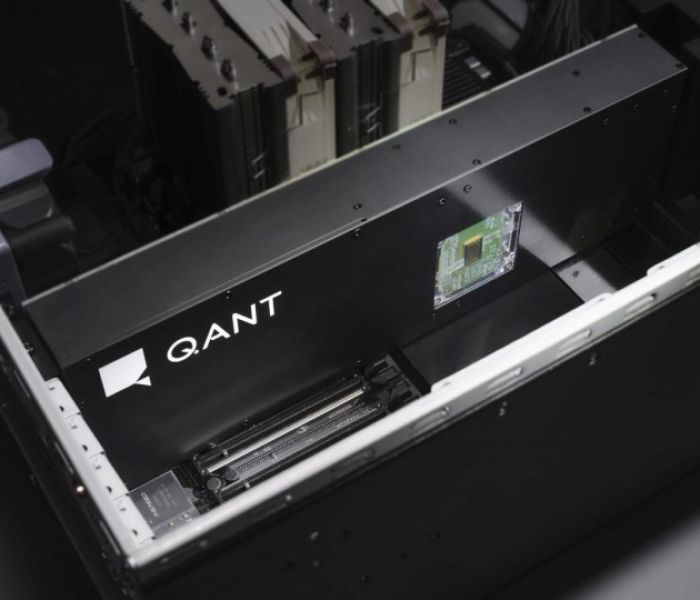
Die schlüsselfertige NPU 2 von Q.ANT (Bild links) (Foto: Q.ant GmbH)
The Q.ANT NPU 2 executes intrinsic, non-linear computations directly through optical processes, designed to dramatically increase both energy efficiency and computing power for artificial intelligence and high-performance computing tasks. Its photonic architecture eliminates conventional electronic bottlenecks and enables unprecedented performance gains. This innovative approach unlocks novel application domains including physics-based AI modeling, advanced robotic control, next-generation computer vision algorithms, high-fidelity physics simulation, and automated pattern detection in complex data streams.
Q.ANT Ships 19-Inch NPS Rack Server with Photonic NPU
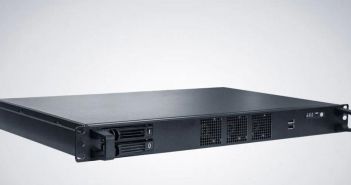
The Native Processing Server (NPS) is delivered as a turnkey 19-inch rack unit that integrates multiple generation-2 photonic processors, an on-board x86 host CPU and a Linux distribution. A modular architecture supports high-density optical compute cores with minimal heat output, while standard PCIe slots and comprehensive C, C++ and Python APIs provide direct access. IT teams can seamlessly install the server into existing CPU, GPU and data center ecosystems.
Photonic data processing drastically reduces energy consumption by up to thirty times while increasing computational performance by as much as fiftyfold compared to traditional electronic processors. This technology performs complex algorithms within the optical domain, virtually eliminating heat buildup and the requirement for bulky cooling mechanisms. Consequently, it enables more sustainable and cost infrastructures. By executing functions in a single optical operation, photonic systems simplify hardware design and system reliability.

Die schlüsselfertige NPU 2 von Q.ANT (Bild links) (Foto: Q.ant GmbH)
Photonics processing replaces CMOS technology by using light to perform computations without generating heat, eliminating the need for complex cooling infrastructure. Optical systems execute multiple nonlinear operations in a single light cycle, replacing thousands of silicon-transistor calculations. Exploiting these benefits, Q.ANTs design cuts energy consumption by up to thirtyfold and increases computational throughput by fiftyfold for demanding AI and HPC workloads, enabling more efficient and sustainable advanced high-performance computing solutions.
Q.ANT Debuts Photonic Q.PAL AI Demonstration at Supercomputing 2025
At the Supercomputing Show 2025 in St. Louis (November 17-21), Q.ANT will showcase an image-based AI learning demonstration at the Leibniz Computing Center booth (#535). The session leverages the Photonic Algorithm Library Q.PAL to illustrate how native optical processing reduces the number of model parameters and computational steps significantly. Attendees will observe real-time training and inference with enhanced precision, comparing performance gains against traditional CPU-based platforms in a live environment.
Next-Gen Photon NPU Cuts Model Parameters While Boosting Performance
The second generation NPU integrates enhanced analog processing modules engineered for nonlinear neural network architectures. These specialized circuits carry out complex mathematical transformations in hardware, minimizing reliance on computationally heavy digital elements. As a result, model parameter counts shrink substantially, training iterations require fewer layers and epochs, and overall processing depth falls dramatically. Consequently, tasks like image recognition, classification, and physics simulations benefit from improved precision and increased resilience.
Featuring a standard 19-inch, two-unit rack profile, this server integrates multiple generation-2 Native Processing Units alongside a Linux-based x86 host. Designed for seamless deployment into existing high-performance computing clusters, it supports PCIe connectivity and offers C, C++ and Python APIs for transparent workload offloading. Administrators can instantly leverage native photonic acceleration without major infrastructure changes, while retaining compatibility with current scheduling systems, storage backends and network fabrics in enterprise environments.
Delivered in a compact 19-inch chassis, the turnkey Native Processing Server integrates several second-generation photonic NPUs alongside an x86 host to deliver unparalleled performance. Its standardized PCIe interface, along with comprehensive C, C++ and Python APIs, ensures seamless integration into existing HPC clusters and data center infrastructures. This plug-and-play solution eliminates the need for extensive software porting, enabling organizations to harness high-throughput optical acceleration with minimal deployment time and effort.
Photonic Processors Accelerate Nonlinear AI Across Manufacturing Logistics Inspection
In sectors such as manufacturing, logistics, and inspection, photonic processors accelerate nonlinear neural network computations with unprecedented efficiency. By processing image-based AI tasks for defect detection, object tracking, and inventory management using fewer parameters, they reduce energy consumption and enable previously impractical computer-vision applications to become economically viable. Additionally, hybrid architectures combining statistical inference and physics-based modeling unlock novel capabilities in drug discovery, advanced material engineering, and dynamic system optimization.
Q.ANT NPU2 Servers Now Orderable, Deliver Photonic Acceleration Mid-2026
The turnkey Q.ANT servers equipped with the second generation NPU 2 are now available for pre-order, with shipments commencing in the first half of 2026. Designed for straightforward integration into existing datacenter infrastructures, these rackmount systems deliver photonic acceleration for compute-intensive artificial intelligence and high-performance computing workloads. Developers and system integrators benefit from immediate deployment capabilities, seamless API compatibility, and substantial energy efficiency and throughput advantages over traditional electronic processors.
Q.ANTs Second-Generation NPU Revolutionizes Computing With Photon-Based Nonlinear Processing
The second generation Q.ANT Native Processing Unit implements an optical computing architecture for efficient native nonlinear operations, delivering fiftyfold performance gains while reducing energy consumption by a factor of thirty compared with conventional CMOS. Packaged in a turnkey nineteen-inch server with integrated x86 host and Linux, the NPS supported by Q.PAL facilitates seamless integration into existing data centers. A live demonstration at Supercomputing 2025 will validate performance under representative workloads.