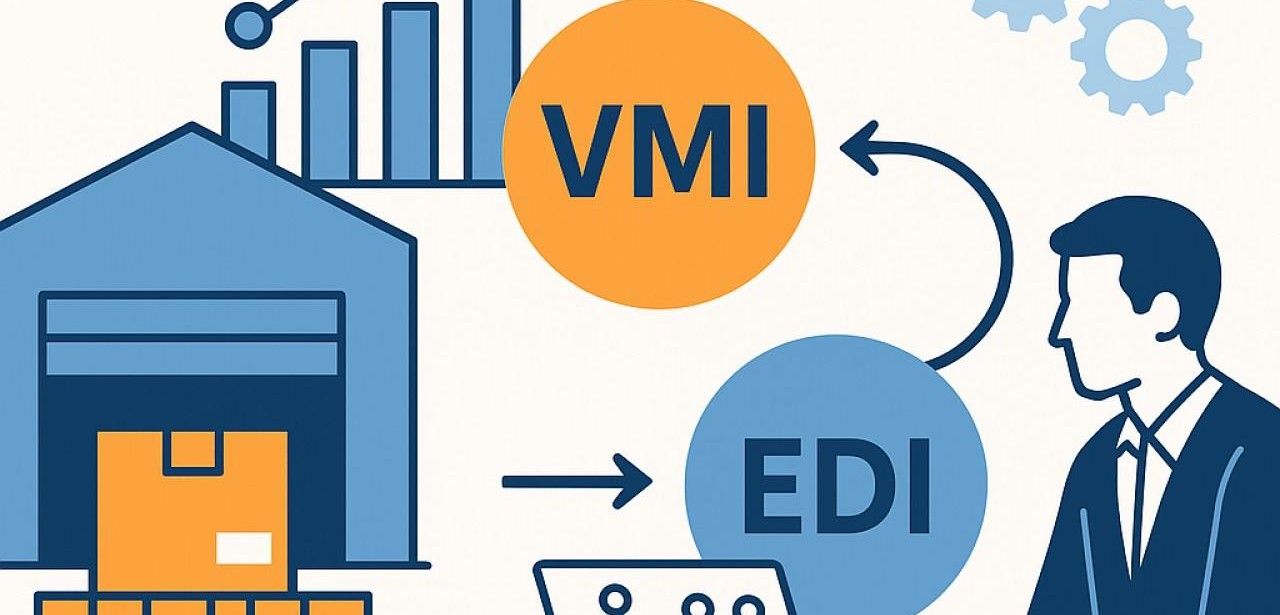
Global supply chains face intense pressure from fluctuating demand and geopolitical uncertainties, complicating planning and risk management. Orbit Logistics addresses these challenges with an E2B dual strategy integrating Vendor Managed Inventory and Collaborative Managed Inventory (VMI/CMI) with automated Electronic Data Interchange (EDI). Leveraging digital automation, real-time analytics and artificial intelligence, it enhances visibility, accelerates order processing, adapts rapidly to market shifts, fortifies resilience and optimizes costs while maintaining service levels.
Table of Contents: What awaits you in this article
Orbit’s E2B dual strategy addresses volatile demand, planning uncertainties
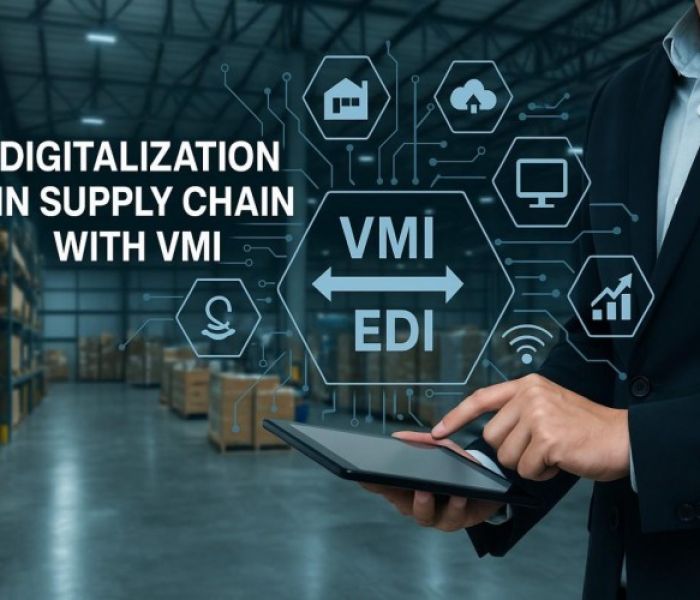
Die E2B-Doppelstrategie: Wenn VMI auf EDI-Automatisierung trifft (Foto: Orbit Logistics Europe GmbH)
Global supply networks face unpredictable demand shifts, geopolitical uncertainties and rising costs. Such pressures disrupt planning accuracy and cause stockouts or overstocking. Orbit Logistics tackles these challenges with its E2B dual strategy, merging Vendor Managed Inventory and Collaborative Managed Inventory with automated Electronic Data Interchange. This integration of real-time inventory visibility and streamlined data exchanges ensures clear supply insights, rapid order processing and enhanced operational flexibility across interconnected logistics ecosystems.
Central Inventory Visibility Reduces Stockouts And Overstocks Through Collaboration
Vendor Managed Inventory (VMI) and Collaborative Managed Inventory (CMI) systems deliver centralized, real-time visibility across stakeholders. By merging stock data, these platforms prevent excess accumulation and shortages of critical inputs such as raw materials, hazardous substances, or specialty chemicals. This shared access empowers participants to forecast needs accurately and schedule replenishment proactively, reducing supply disruptions. Consequently, businesses optimize working capital, streamline procurement cycles, lower emergency orders, cost savings, operational continuity.
EDI delivers standardized, instant data exchange between suppliers, customers
Electronic Data Interchange standardizes and instantly delivers transaction records between suppliers and customers, eliminating manual, error-prone data transfers. Fully automated Order-to-Cash and Procure-to-Pay workflows streamline orders, invoices, and confirmations while reducing administrative overhead. SaaS-based EDI platforms offer scalable, cloud-native deployment and rapid integration, ensuring seamless connectivity across trading partners and systems. As a result, order accuracy improves significantly, processing times shrink measurably, and operational efficiency increases throughout the supply chain.
E2B Dual Strategy Combines VMI/CMI and EDI for Synergy
Integrating Vendor Managed Inventory and Collaborative Managed Inventory with Electronic Data Interchange produces synergy through the E2B strategy. Real-time visibility merges with automated responses to eliminate manual delays, streamline workflows, and reduce data inaccuracies. Organizations experience lower error rates, faster decision cycles, and improved responsiveness to demand fluctuations. Additionally, this methodology enhances resilience by detecting potential disruptions in advance and initiating corrective measures automatically to maintain uninterrupted supply chain stability.
Artificial intelligence enhances E2B principle precision, autonomous inventory management
Leveraging artificial intelligence, the E2B framework becomes markedly more accurate and adaptive. Advanced algorithms continuously process inventory metrics alongside external market signals to refine demand forecasts in real time. Automated workflow orchestration layers more intelligence by identifying historical trends and dynamically adjusting replenishment thresholds, which shortens decision cycles. This near-autonomous operation reduces carrying costs, minimizes stockouts, and elevates service quality. This integration drives efficient resource utilization and sustained competitive advantage.
Orbit Logistics E2B Strategy Integrates VMI CMI And EDI
Orbit Logistics E2B dual strategy merges vendor managed inventory and collaborative managed inventory with automated electronic data interchange, creating leverage to enhance supply chains. By combining centralized inventory oversight and real-time data synchronization, organizations gain transparency, speed. Flexible replenishment and expedited order-to-cash cycles ensure rapid response to market volatility. Resilience is fortified through early risk detection and corrective measures. Future AI integration promises predictive insights, cost reduction and service excellence.