

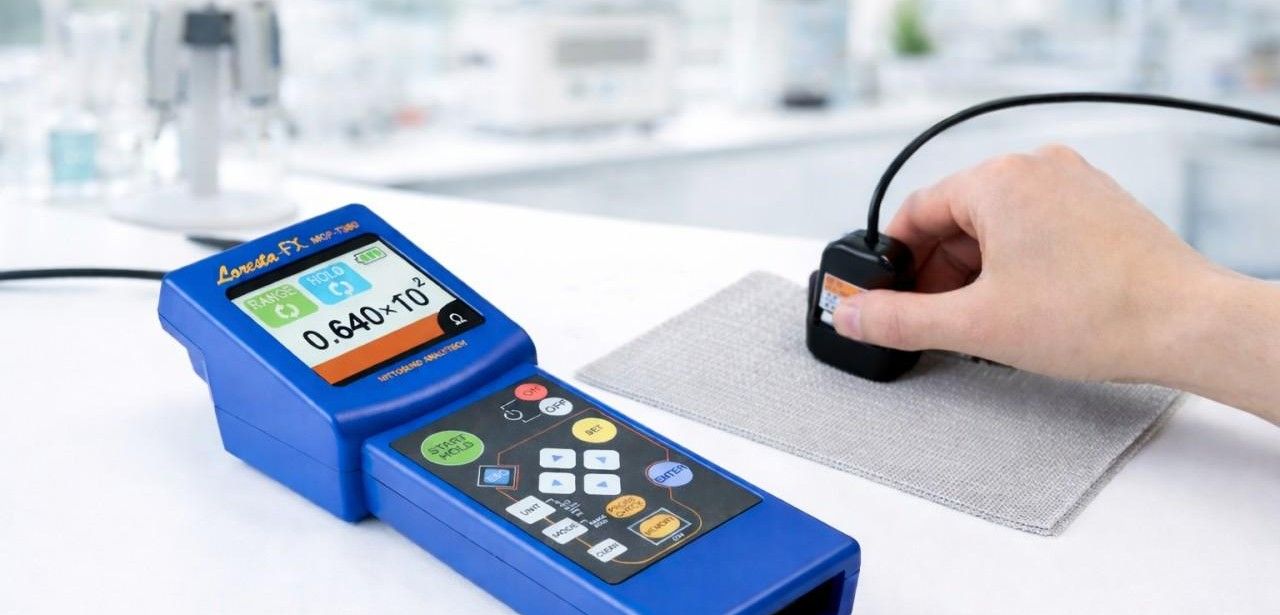
Choosing an appropriate measurement technique for determining electrical conductivity impacts efficiency, accuracy, and reliability in research and production. Although traditional two-point measurement with a standard multimeter provides an affordable, straightforward approach, its performance degrades when measuring very low resistances. Conversely, the four-terminal method separates current injection from voltage sensing, eliminating contact and lead resistances to yield consistent, repeatable, high-precision conductivity results applicable across diverse industrial and scientific applications and scalability.
Table of Contents: What awaits you in this article
Simple Two-Point Conductivity Measurement Fails Precision Under Low Resistance
Many workshops begin with simple two-point measurements of electrical conductivity using conventional multimeters due to their intuitive operation and low initial cost. However, when accurate determination of very low resistance values becomes essential, the methods inherent contact and lead resistances introduce significant measurement errors. These parasitic resistances compromise material characterization, making it difficult to obtain reliable data. Consequently, researchers and technicians face challenges ensuring confidence in conductivity analyses and results.
Four-Wire Setup Separates Current And Voltage, Boosting Measurement Accuracy
By separating test current injection and voltage measurement, the four-wire method uses two electrodes for current supply and two separate sensors to measure the potential drop across a sample under controlled test conditions. This arrangement bypasses contact and lead resistance, ensuring that extraneous resistances do not affect readings. Consequently, the true material resistance is established with exceptional accuracy, supporting reliable assessment of low-resistance materials under various laboratory and production scenarios.
Four-Point Method Excels Across 10^-6 to 10^7 Ω·cm
In the measurement of electrical resistivity for metals, semiconductors and materials across a range from 10^-6 to 10^7 ohm-centimeters, the four-point probe technique demonstrates superior accuracy. By isolating current injection and voltage sensing paths, this method eliminates contact resistance and cable-induced errors, ensuring reproducible, standards-compliant results. Because of its precision, the four-probe configuration has become a widely adopted standard within global research laboratories, development departments, and industrial testing environments.
Sample Geometry Pressure Temperature Homogeneity Crucial For Reliable Measurement
In addition to the chosen measurement technique, multiple factors such as the specimens shape, the electrode contact force, ambient temperature, and material uniformity can significantly affect conductivity readings. Establishing precise calibration between the measurement instrument, the mechanical test fixture, and the standardized procedural steps is critical. Rigorous synchronization and environmental control help minimize variability, ensure that electrical resistance values truly represent material properties, and facilitate consistent comparisons across experimental setups.
Automated Four-Point Conductivity Measurements Enable Rapid, Reproducible High-Throughput Analysis
Modern conductivity measurement instruments employ automated four-point sensing for rapid results. These systems support high-throughput evaluation of material samples by reducing manual intervention and optimizing measurement cycles. Enhanced sensitivity enables precise characterization of thin conductive coatings, polymer composites, and powder materials across research disciplines such as battery development. By standardizing test parameters and eliminating contact resistance, they deliver consistent benchmarking, reliable performance data, and insights for process control and optimization.
Four-wire method enables material characterization and reliable process control
For engineers, materials scientists and quality assurance managers, the four-wire technique represents an indispensable tool to achieve accurate characterization of electrical resistance and conductance. By separating current injection from voltage measurement, it ensures elimination of contact resistance errors and delivers consistent readings across a broad spectrum. Seamlessly integrable, scalable into existing test setups, this methodology supports process validation protocols and enhances confidence in trials and in-line production monitoring without reconfiguration.
Four-Point Method Eliminates Resistive Errors, Delivering Precise Conductivity Measurements
The four-terminal measurement technique outperforms conventional two-point methods by removing offsets caused by contact and lead resistances. By separating current injection and voltage sensing, it guarantees precise readings across low to high resistance materials. Automated modern instruments accelerate data collection, ensuring excellent repeatability and throughput in environments. This approach adapts seamlessly to applications in coatings, polymers and powder analysis, making it indispensable for robust material characterization and process control requirements.