
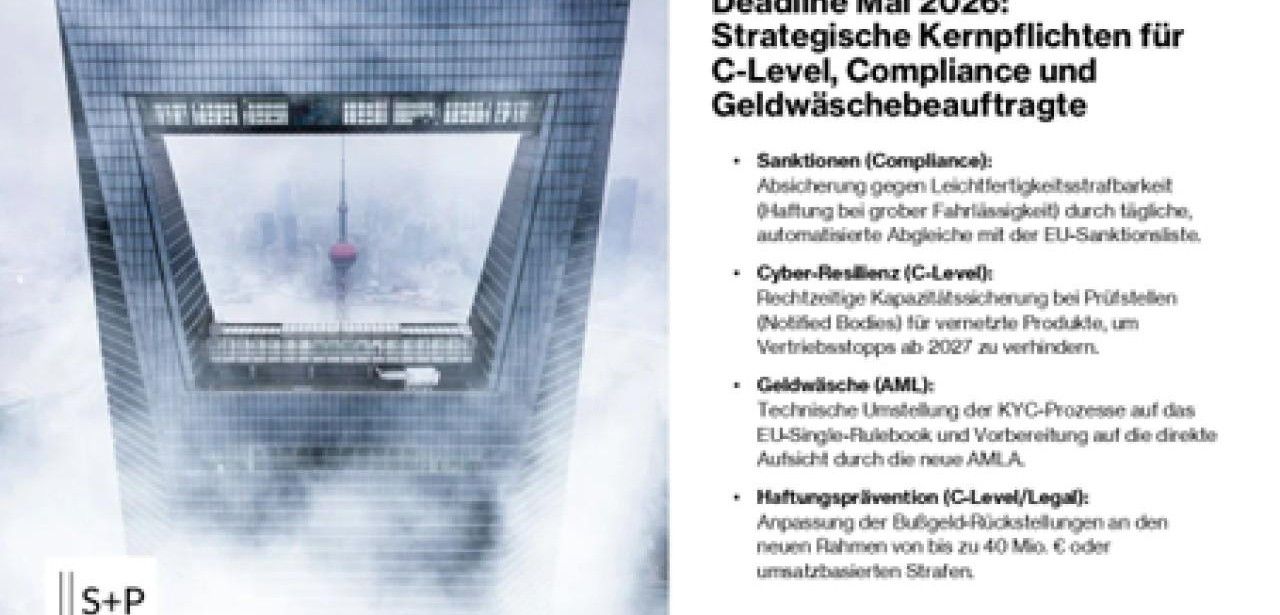
By May 2026, transitional periods for EU Sanctions Directive 2024/1226, Cyber Resilience Act (EU 2024/2847), and AML Regulation (EU-AMLR) will expire. Organizations secure legal certainty by implementing real-time screening of the Financial Sanctions Database, obtaining early CRA conformity assessments, and adopting harmonized Know-Your-Customer processes. These measures reduce executive liability, ensure market access, streamline anti-money laundering compliance, and strengthen operational resilience through automated alerts and documented evidence prepared for regulatory inspections.
Table of Contents: What awaits you in this article
Real-Time Sanctions Screening Under EU Directive Reduces Liability Risks
The implementation of EU Sanctions Directive 2024/1226 intensifies criminal liability for negligent violations under § 18 AWG n.F. By integrating mandatory real-time screening against the Financial Sanctions Database, businesses achieve legal certainty. Automated database updates within hours reduce exposure for executive officers and compliance managers. This monitoring framework curtails potential penalties reaching ?40 million or corresponding turnover-based sanctions. Organizations benefit from processes, minimized oversight gaps, and fortified defense against regulatory enforcement actions.
Notified body bookings ensure CE marking for networked products
The Cyber Resilience Act (Regulation EU 2024/2847) will designate accredited conformity assessment bodies such as TÜV and DEKRA starting in May 2026. By securing testing slots early with notified bodies, manufacturers ensure CE marking for connected products from 2027 onward, avoiding sales interruptions. Companies gain advantages through predictable certification timelines, streamlined SBOM management and market entry. These measures also promote enhanced transparency and reinforce product cybersecurity compliance and operational resilience.
EU AMLR RTS End National GwG, Simplify KYC Processes
Implementation of the AML Regulation (EU-2024/1620) together with the new AMLA RTS abolishes national AML exceptions. Standardized KYC workflows and uniform risk assessment frameworks simplify complexity and reduce compliance expenditures. Corporations benefit from standardized technical directives, enhanced cross-border surveillance, decreased audit liabilities transitioning to direct EU oversight from 2028. This harmonized regulatory landscape fosters predictable compliance processes and strengthens anti-money laundering defenses, delivering strategic efficiency improvements across international banking operations.
Enforcing mandatory disclosure of compensation levels across roles, the EU Pay Transparency Directive creates an open environment where employees verify equitable pay. The regulation requires employers to keep comprehensive salary records and provides workers with comparative pay data, boosting legal certainty. By shifting the burden of proof onto employers in discrimination disputes, the directive accelerates claim resolution. As a result, organizations reduce litigation exposure and demonstrate dedication to workplace fairness.
From June 2026, the EU Pay Transparency Directive reverses the burden of proof requiring employers to maintain comprehensive documentation of remuneration structures. Through proactive salary and role analyses, organizations foster transparency, mitigate risks of unlimited claims, avoid exclusion from public procurement processes. HR and compliance teams benefit from enhanced planning capabilities, defense mechanisms against discrimination allegations, structured approach ensuring consistent evidence management to satisfy legal obligations and improve workforce equity.
CRA mandates technical documentation and vulnerability reporting to BSI
Under the Cyber Resilience Act, organizations must produce comprehensive technical documentation and submit regular vulnerability reports to the German Federal Office for Information Security. Implementing a Software Bill of Materials enhances supply chain transparency, enabling efficient patch management and component tracking. By meeting these requirements, companies strengthen robust cyber resilience, comply with incident reporting obligations, and build trust among customers and partners through demonstrated product integrity and transparent security practices.
By integrating the EU Sanctions Directive 2024/1226, the Cyber Resilience Act, and AMLR with AMLA standards ahead of deadlines, companies significantly reduce executive liability and secure market entry. This proactive approach simplifies anti-money laundering compliance through harmonized KYC processes while strengthening operational resilience with standardized protocols. Aligning policies across these frameworks prevents substantial fines, supply chain interruptions, and discrimination allegations. Organizations thereby protect leadership, preserve reputation, and gain competitive advantages.