
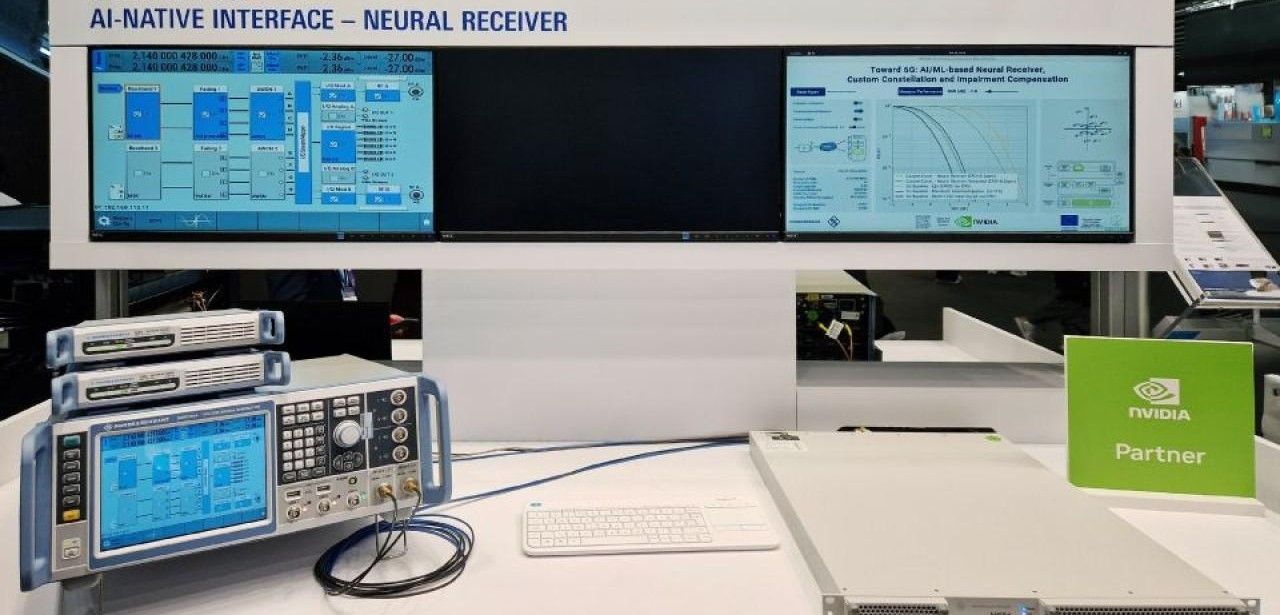
In mid-March 2026 at MWC Barcelona, Rohde & Schwarz and NVIDIA unveil a hardware-in-the-loop testbed designed to validate AI-driven radio access network applications in lab settings. Integrating NVIDIA’s Sionna Research Kit with differentiable ray-tracing technology, the platform supports location-specific channel emulation, real-time artificial intelligence inference, digital twin testing. Collaborative solution empowers developers to create reliable prototypes and implement realistic 5G-Advanced and emerging 6G evaluation procedures using innovative, efficient measurement techniques.
Table of Contents: What awaits you in this article
Rohde & Schwarz, NVIDIA unveil AI-driven hardware-in-loop RAN testbed
At MWC Barcelona 2026, Rohde & Schwarz and NVIDIA introduce a hardware-in-the-loop testbed that combines NVIDIAs Sionna Research Kit with differentiable ray-tracing for location-specific channel emulation. This integrated system enables precise real-time modeling of dynamic radio conditions inside the laboratory. By leveraging digital twin technology, developers can evaluate AI-RAN algorithms under authentic propagation scenarios without field trials, accelerating prototyping, optimizing performance, and ensuring reliable AI-driven radio system validation ahead of deployment.
NVIDIA DGX Spark Enables AI Modulation Optimization in 5G
At the heart of the testbed is a single NVIDIA DGX Spark running a software-defined 5G RAN stack via OpenAirInterface and the NVIDIA Sionna Research Kit. This integrated platform adheres to stringent real-time wireless performance requirements while handling demanding AI inference workloads. A novel AI/ML-driven link adaptation algorithm continuously adjusts downlink modulation and coding schemes based on live channel observations, optimising spectral efficiency, connection reliability and site-and device-specific propagation characteristics.
Closed-Loop AI-RAN Testing with R&S Instruments and NVIDIA Ray-Tracing
By integrating the R&S SMW200A vector signal generator, equipped with dynamic channel emulation, and the FSW signal and spectrum analyzer, the testbed generates complex, site-specific radio channels in a closed-loop configuration. These instruments feed real-time, differentiable ray-traced propagation data from NVIDIAs Sionna software, enabling realistic evaluation of AI-based RAN functions under variable RF conditions within the laboratory. This approach eliminates the need for external field trials, significantly accelerating development cycles.
Digital Twin Ray-Tracing Bridges Simulation To Reality For 5G-Advanced
Gerald Tietscher, Vice President of Signal Generators at Rohde & Schwarz, explains that integrating Digital Twin technology with advanced Ray-Tracing bridges the gap between simulation and deployment. This synergy delivers more accurate testing environments for 5G-Advanced and 6G systems. Soma Velayutham of NVIDIA highlights that employing the Sionna Research Kit for synthetic data generation ensures fidelity, scalability, and privacy safeguards. The collaboration accelerates advancements in AI-driven RAN development and optimization.
Experience live hardware-in-the-loop AI-RAN validation at MWC Barcelona 2026
Attendees at MWC Barcelona between March 2 and 5, 2026 will have the opportunity to witness a live demonstration of hardware-in-the-loop validation for AI-driven radio access network features. Hosted at booth 5A80 in hall 5, this showcase invites participants to engage directly with engineers and specialists from Rohde & Schwarz and NVIDIA. Detailed insights into advanced AI and machine learning methods for 6G network optimization can be accessed via www.rohde-schwarz.com/6G-AI-ML.
This testbed developed by Rohde & Schwarz and NVIDIA integrates differentiable ray-tracing, digital twin modeling, and AI inference within a closed-loop environment. Users gain realistic channel emulation under precise real-time constraints, enabling evaluation of dynamic link adaptation algorithms that adjust modulation and coding schemes autonomously. By replicating location-specific propagation characteristics in real time, the platform accelerates prototype validation and optimization for 5G-Advanced and next-generation 6G networks, supporting rapid product development and dependable radio performance.