From May 5 to May 6, 2026, the Quantum Photonics conference at Messe Erfurt brought together specialists, companies, and research institutions in quantum technology and photonics. The event featured a conference program with presentations on quantum computing, quantum key distribution, and quantum sensing, alongside an exhibition showcasing eighteen vendors including X-FAB, May Distribution, and PhoQS. Focus was placed on fostering strategic networking, exploring industrial applications, and assessing long-term technological prospects.
Table of Contents: What awaits you in this article
Erfurt hosts Quantum Photonics bridging quantum technology with industry
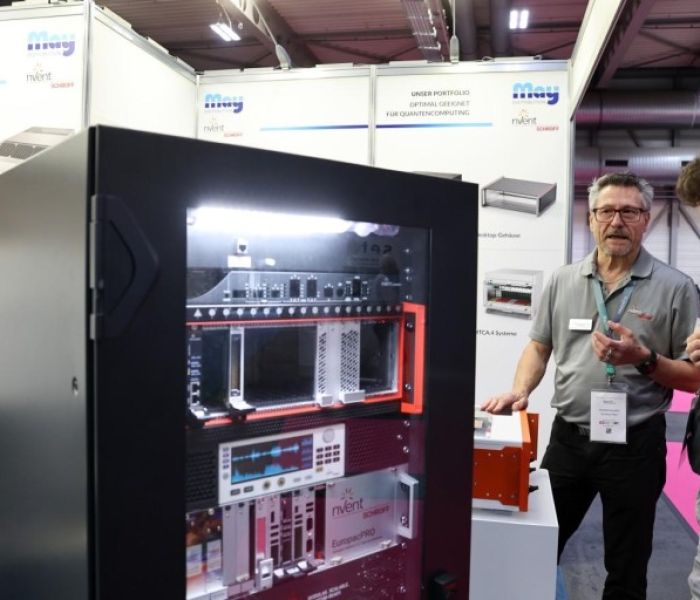
Präsentation am Stand von May Distribution (Foto: Karina Hessland-Wissel)
At the opening of the second Quantum Photonics conference in Erfurt, Michael Kynast, CEO of Messe Erfurt GmbH, stressed that quantum technology and photonics are tightly interconnected. He underscored the events combination of a conference and an exhibition as a critical link between science and industry. Eighteen exhibitors displayed their latest innovations while experts moderated four forums focused on quantum computing, cybersecurity, defense and space applications, and advanced metrology technologies.
X-FAB unveils custom automotive, aerospace, MEMS circuits at exhibition
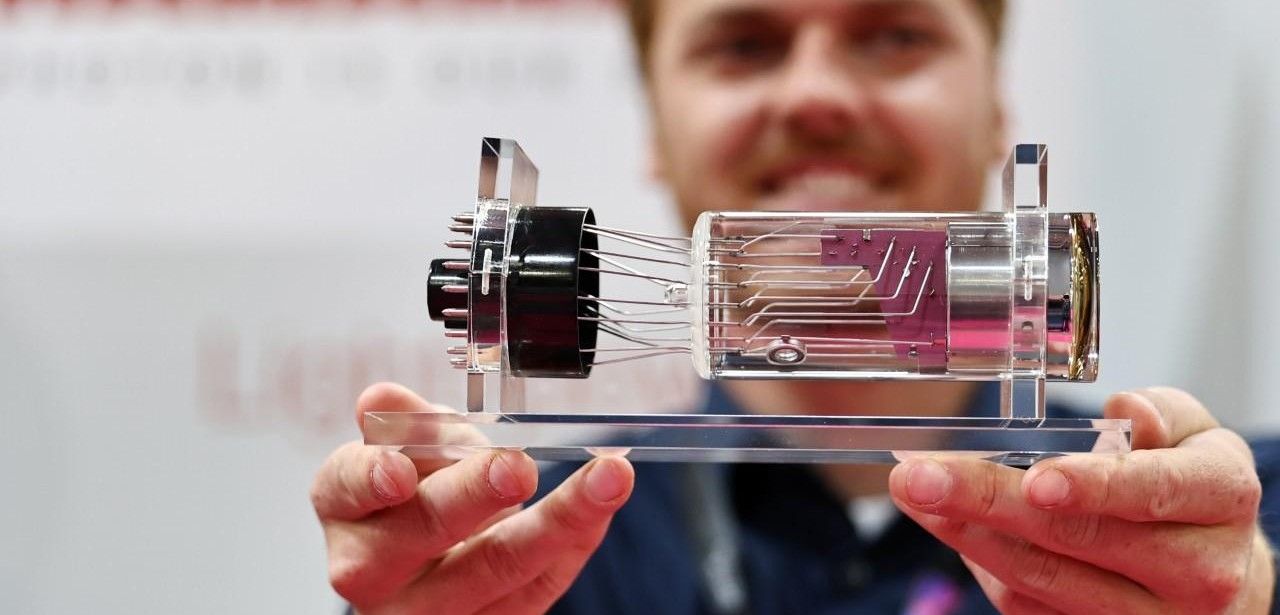
At the exhibition, semiconductor manufacturer X-FAB showcased its customized integrated circuits designed for automotive, aerospace, and micro-electromechanical systems (MEMS) applications, demonstrating advanced process technologies and design capabilities. Emphasizing their versatility and high performance, company representatives highlighted examples of precision manufacturing workflows and reliability testing. CEO Muralikrishna Sathyamurthy underscored Thuringias growing reputation as an optoelectronic hub and praised Quantum Photonics for fostering regional collaboration and facilitating new robust partnership development cycles.
May Distribution unveils modular scalable quantum photonic control platforms
May Distribution, based in Berlin, introduced modular control platforms designed to support scalable quantum and photonic operations. These systems integrate advanced cooling mechanisms, standardized hardware modules, and comprehensive engineering services, significantly shortening development cycles. By leveraging standardized interfaces and robust thermal management, their architecture delivers reduced latency, precise timing alignment across subsystems, and superior signal integrity. According to Dipl.-Ing. Peter Siebertz, this modular approach optimizes performance in quantum photonics environments.
PhoQS showcases photon-based quantum simulation, communication, metrology and computing
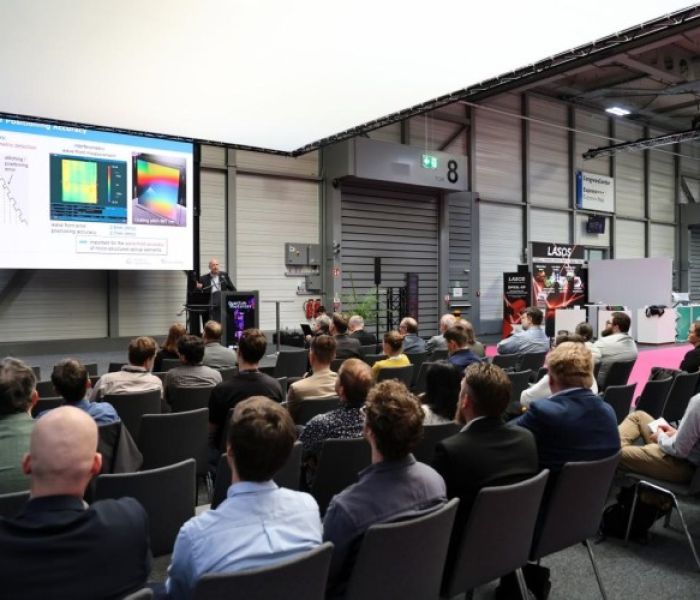
Kick-Off DFG-Projekt 3D-NLM (Foto: Karina Hessland-Wissel)
At the Institute for Photonic Quantum Systems PhoQS, researchers showcased advanced implementations across quantum simulation, secure quantum communication networks, precision quantum metrology and scalable photonic quantum computing architectures. Philip Held highlighted the pivotal role of collaborative partnerships between academic research groups and industrial stakeholders, advocating for cooperation to expedite development cycles, facilitate prototyping and ensure technology transfer. Strategic integration aims to mature photonic quantum solutions and achieve real-world system deployment.
Photonic Quantum Computing Forum Explores Photon Loss Minimization Strategies
In the Quantum in Computing & AI forum, Dr. Rene Sondenheimer presented advancements in photonic quantum computing, focusing on strategies to reduce photon losses in quantum processors. His analysis covered waveguide optimization and integration with photonic circuits to mitigate losses. Meanwhile, Dr. Matthias Pfender of NVision explained organic quantum platforms using photoactive triplet carbene molecules in crystalline matrices as alternative qubit structures, detailing fabrication processes, coherence characteristics, and scalability prospects.
Experts unveil QKD testbeds, entangled photon sources, certification frameworks
Four specialists showcased state-of-the-art methods for quantum key distribution. Dr. Nils Gentschen Felde described MuQuaNet, an integrated QKD testbed optimized for the Munich metropolitan region, featuring infrastructure performance benchmarking. Dr. Natalie Jung from TÜVIT outlined comprehensive evaluation laboratories and certification frameworks for regulatory compliance security validation. Dr. Alessandro Zannotti demonstrated entangled photon sources developed by Quantum Optics Jena, while Fraunhofer IPMS explored affordable photon-integrated circuit architectures enabling efficient quantum communication.
Optical Ground Station Jena Supports European QKD Satellite Development
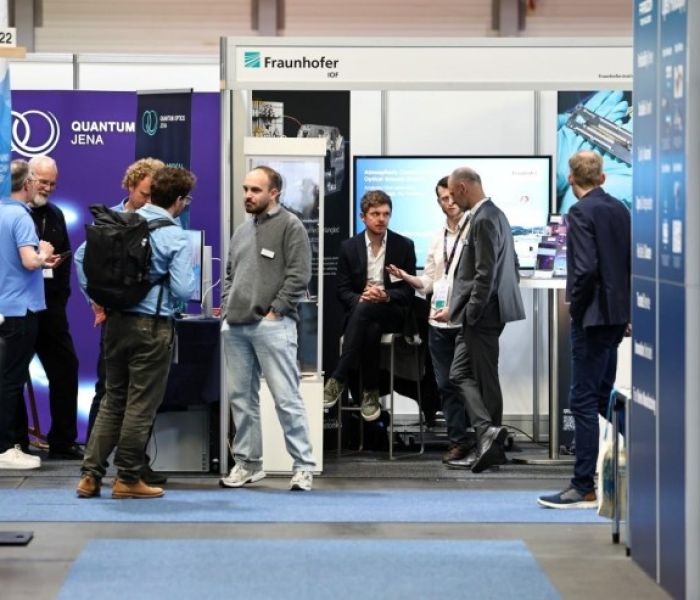
Ausstellungsbereich zur Quantum Photonics (Foto: Karina Hessland-Wissel)
In the Defence and Space Forum, Dr. Matthias Goy of Fraunhofer IOF outlined the Optical Ground Station in Jena and the TransEuroOGS consortium preparing European QKD satellites such as Eagle-1. Dr. Seid Koudia of the University of Luxembourg tested quantum memory prototypes for Low Earth Orbit deployment and assessed their technological readiness levels and reliability. Meanwhile, Arda Atomics demonstrated integration of quantum gyroscopes in CubeSats to advance on-board navigation precision.
DFG-funded 3D-NLM facility develops meter-scale photonic component nanostructuring system
The DFG-funded 3D-NLM initiative is advancing a specialized system for ultrafine structuring and characterization of photonic elements reaching one meter dimensions. Researchers focus on integrating precise nanofabrication with real-time measurement tools, ensuring sub-micron accuracy across extensive surfaces. Dr. Uwe Zeitner from Fraunhofer IOF and Dr. Thomas Kissinger of TU Ilmenau spearhead methods for in-situ calibration procedures, enabling quality assessment and adaptive machining of large-scale components destined for astrophysical spectrometer applications.
Researchers Showcase Superconducting Single-Photon Detectors and Entanglement-Based Quantum Sensors
In the final session, Prof. Dr. Ronny Stolz showcased superconducting single-photon detectors with high timing resolution, alongside quantum sensors exploiting photon entanglement for remarkable sub-femtotesla sensitivity. Matthias Meyer of Supracon introduced four quantum magnetometer models, including nitrogen-vacancy center devices delivering nanoscale magnetic mapping. The session closed with Prof. Dr. Jan Meijer from University of Leipzig unveiling diamond color center sensors with quantum yield, introducing the new Quantum Technologies GmbH startup.
Nine Coffee Pitches Highlight Polarizers, Quantum-Phase Sensors, Squeezed-Light Computing
In nine Coffee Pitch sessions, specialists explored optical polarizers, advanced quantum phase sensing methods, and computing architectures leveraging squeezed light. These concise talks, held during coffee breaks, transformed downtime into informative, high-impact presentations that deepened understanding of photonic quantum technologies. The informal format encouraged spontaneous dialogue among attendees, facilitating the exchange of practical insights, emerging research findings, and potential collaboration opportunities. Participants departed with enhanced awareness of state-of-the-art quantum optics.
The Quantum Photonics 2026 event in Erfurt demonstrated its significant role as a bridge between academia and industry, accelerating partnership formation by facilitating direct collaboration among researchers, suppliers. Modular system designs introduced during the exhibition reduced development cycles for photonics control units and quantum devices. Regional optoelectronic firms gained access to networks, while the integration of certification frameworks and application-focused research laid the groundwork for scalable quantum technologies lasting innovation.