
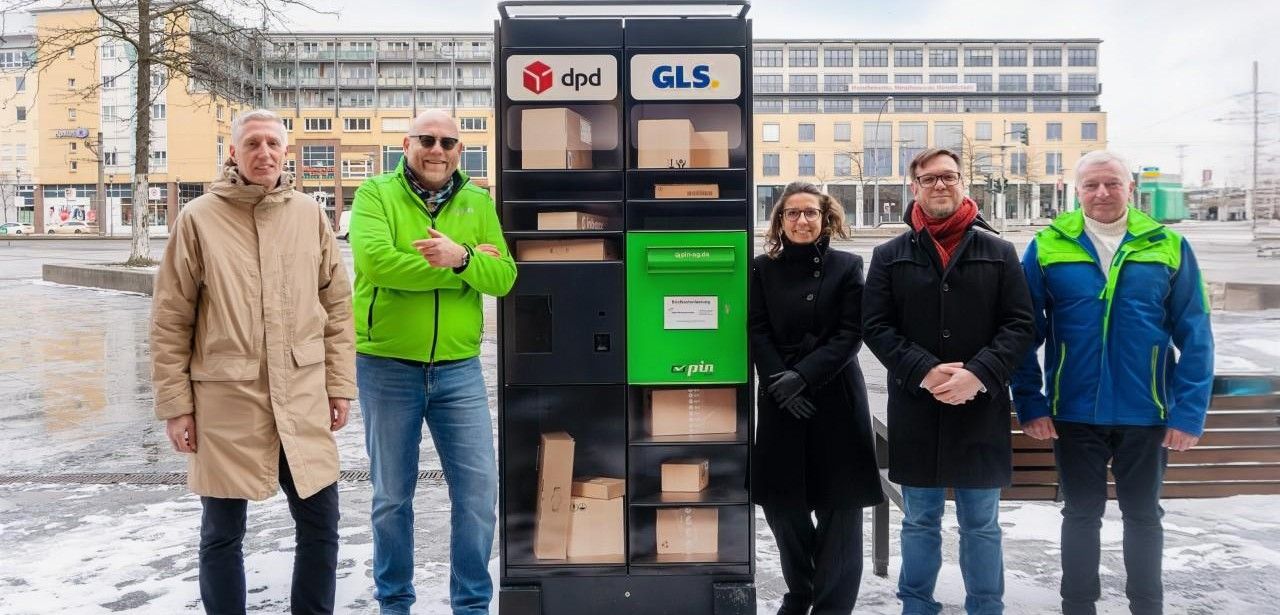
With a pilot initiative in Berlins Marzahn-Hellersdorf, GLS Germany, DPD Deutschland, and PIN AG introduce inboxx, a hybrid parcel station network. Thirteen open-access terminals integrate cross-carrier parcel delivery, collection services, and an embedded letterbox for outgoing mail. Recipients can conveniently receive, dispatch packages, and deposit letters at any station. In partnership with the district office, the project aims to consolidate delivery routes, increase operational efficiency, and foster sustainable urban logistics.
Table of Contents: What awaits you in this article
First thirteen inboxx hubs launch across Marzahn-Hellersdorfs central locations
The initial rollout of thirteen inboxx stations has been completed at key public locations including Alice-Salomon-Platz, Hellersdorfer Straße, Hönower Straße, Köpenicker Straße, and Helene-Weigel-Platz. Over the next few weeks, additional units will be installed along the Allee der Kosmonauten, expanding service coverage. Developed in collaboration with the Marzahn-Hellersdorf district administration, this pilot initiative aims to evaluate innovative delivery models for urban logistics, improving operational efficiency, reducing vehicle movements, enhancing customer convenience.
GLS and DPD launch open inboxx integrating PIN-AG mailbox
GLS and DPDs open-access inboxx stations integrate a PIN AG mailbox, enabling recipients to handle packages and letters at a location. By merging parcel and postal services, this hybrid facility takes advantage of both logistics providers networks, optimizes locker occupancy and reduces infrastructure redundancy. Users experience greater convenience and flexibility, while operators benefit from increased throughput and resource efficiency. Additional hardware installations remain unnecessary to support this unified service model.
Partnership Enables Open Package Stations For Sustainable Urban Logistics
In her statement, Marzahn-Hellersdorf Mayor Nadja Zivkovic underscores open-access parcel stations as a crucial component of future-proof urban infrastructure. She explains that these stations consolidate delivery services into a shared network, minimizing redundant trips and traffic congestion. This approach enhances efficiency on the last mile and offers residents flexible collection and dispatch options at any hour. The cooperative model exemplifies sustainable logistics achieved through strategic partnerships.
GLS, DPD and PIN-AG trial inboxx last-mile logistics solution
GLS Manager of Strategic Partnerships Out of Home, Henry Lohmeier, regards the inboxx project as a clear indicator of evolving last-mile logistics. In collaboration with DPD and PIN AG, he highlights Berlin’s evaluation of this modern parcel delivery solution. PIN AG’s COO, Bernd Fricke, notes that integrating their mailbox modules creates advantages. In times of constrained urban space, pooling delivery and systems boosts operational efficiency, reduces footprint, and maximizes resources.
Insights into hybrid logistics acceptance fuel inboxx network expansion
Insights from the pilot will clarify acceptance and operational benefits of hybrid package and mail lockers in public spaces. By integrating multicarrier resources, the initiative evaluates user engagement with combined parcel and letterbox stations. Leveraging GLS’s network of over 10,000 existing pickup points, GLS and DPD plan to extend an open, carrier-neutral Out-of-Home network to 20,000 sites, with Berlin as the launch city. Inboxx stations act as enablers for expansion.
Hybrid inboxx Cuts Traffic, Saves Resources, Boosts Urban Efficiency
GLS, DPD, and PIN AGs pilot initiative introduces hybrid, carrier-neutral inboxx stations aimed at transforming logistics. By integrating parcel and mail services within hubs, the system enhances operational efficiency, providing recipients with convenient, on-demand access. Consolidation of delivery and pickup processes optimizes route density, minimizes vehicle mileage, and contributes to lower emissions and reduced traffic congestion. Insights gathered from this trial will inform the scalable deployment of sustainable, low-impact distribution networks.